
5 Financial Documents Every Indian Should Keep Safe
Discover the five essential financial documents every Indian should keep secure. Staying organized can simplify tax filing, loan applications, financial planning, and help you avoid unnecessary stress when important documents are needed.
FINANCIAL KNOWLEDGEDOCUMENTATION
CA Nancy Singhal
7/15/20263 min read
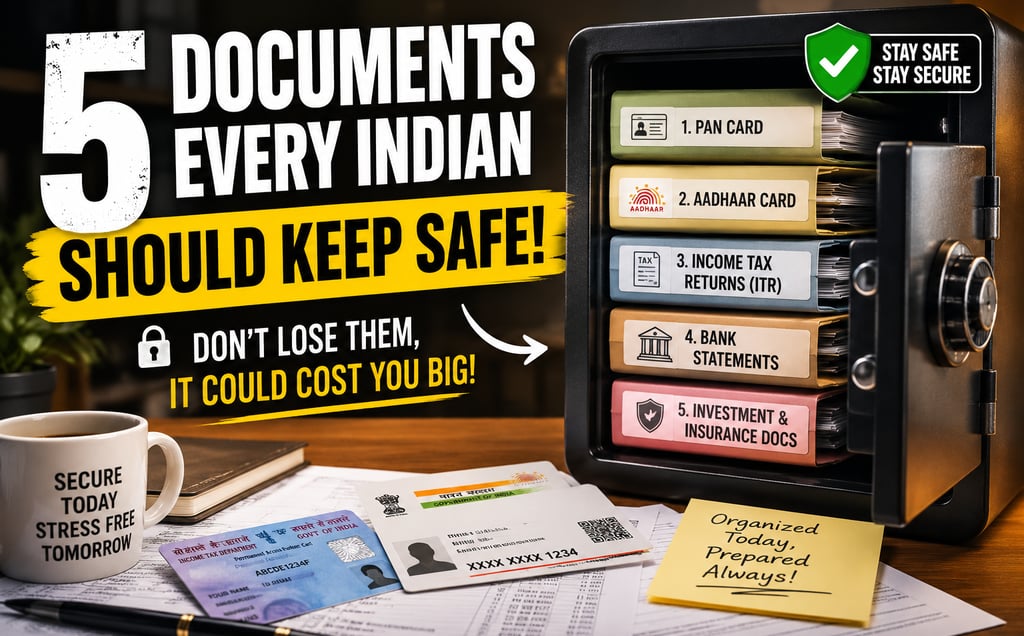
5 Financial Documents Every Indian Should Keep Safe
Keywords: Important Financial Documents in India, PAN Card, Aadhaar Card, Income Tax Return, Bank Statements, Financial Planning, Personal Finance India
Have you ever spent hours looking for an important document just when you needed it the most?
Maybe while applying for a loan...
Opening a bank account...
Filing your Income Tax Return...
Or completing office paperwork.
It happens to almost everyone.
The truth is, most people don't realize the importance of financial documents until they're suddenly asked to produce them.
Keeping your important documents safe isn't just about staying organized. It saves time, reduces stress, protects you from fraud, and makes your financial life much easier.
Let's look at five important financial documents every Indian should keep safe and why they matter.
1. PAN Card – Your Financial Identity
Your Permanent Account Number (PAN) is one of the most important financial documents in India.
Think of it as your financial identity.
You'll need your PAN Card for:
Filing your Income Tax Return (ITR)
Opening a bank account
Investing in mutual funds or stocks
Buying or selling property
Applying for loans
Many other financial transactions
If your PAN card is lost, many important tasks can become difficult.
Pro Tip: Keep both a physical copy and a scanned copy saved securely on your phone or cloud storage.
2. Aadhaar Card – Your Identity Proof
Today, your Aadhaar Card is required almost everywhere.
Whether you're:
Opening a bank account
Applying for a government scheme
Completing KYC
Buying a SIM card
Linking financial accounts
Your Aadhaar makes the process much simpler.
Since it contains your personal information, make sure you don't share copies unnecessarily.
Always keep your Aadhaar updated with your latest mobile number and address.
3. Income Tax Returns (ITRs)
Many people think that once they file their Income Tax Return, the job is done.
Not really.
Your previous ITRs are extremely valuable.
Banks often ask for them when you apply for:
Home loans
Car loans
Business loans
Personal loans
Credit cards
They may also be required while applying for visas or proving your income.
Even if you're a salaried employee, keeping copies of your last few ITRs is a very good habit.
Save both the acknowledgment and the complete return safely.
4. Bank Statements
Your bank statement tells the story of your money.
It shows:
Salary credits
Business income
Expenses
Investments
Loan EMIs
Interest earned
Many people ignore bank statements until they need them urgently.
Banks, CAs, loan companies, and even visa authorities may ask for statements from the last six months or even one year.
Downloading your statements regularly ensures you always have them when required.
It's also a great way to spot any suspicious transactions quickly.
5. Investment and Insurance Documents
Whether you've invested ₹500 or ₹5 lakh, every investment deserves proper documentation.
Keep records of:
Mutual Funds
Fixed Deposits
Shares
PPF
NPS
Life Insurance
Health Insurance
Property Papers
These documents become extremely important during:
Income Tax filing
Insurance claims
Loan applications
Financial planning
Family emergencies
Many families don't know where these papers are kept until something unexpected happens.
A simple folder can save a lot of confusion later.
Bonus Tip: Create a "Financial Folder"
One simple habit can make your life much easier.
Create one folder called "Important Financial Documents."
Keep both:
Physical copies in a waterproof file.
Digital copies in Google Drive, OneDrive, or another secure cloud storage.
Organize them into folders like:
PAN & Aadhaar
Bank
Income Tax
Investments
Insurance
Property
This way, you'll never waste time searching for documents again.
Why This Small Habit Makes a Big Difference
Imagine receiving a call from the bank asking for your latest ITR.
Or your CA asking for your investment proofs.
Or your employer requesting your PAN details.
Instead of searching every drawer in your house, you can simply open one folder.
Being financially organized isn't about earning more money.
It's about managing your financial life wisely.
The people who stay organized often avoid unnecessary delays, paperwork, and stress.
Final Thoughts
Managing your finances doesn't have to be complicated.
Sometimes, a few simple habits can make a huge difference.
Keeping your important financial documents safe helps you file taxes easily, apply for loans without hassle, protect yourself from fraud, and stay prepared for life's unexpected situations.
Start today.
Take just 30 minutes to gather your important documents and store them safely.
Your future self will thank you.
Need Help Managing Your Financial Documents?
At Singhal Tax Advisors & Consultants, we help individuals, professionals, startups, and businesses stay financially organized with expert guidance on Income Tax Returns, GST, bookkeeping, compliance, and financial planning.
If you're unsure about which documents you should maintain or need assistance with your tax and compliance requirements, our team is always here to help.
Singhal Tax Advisors & Consultants
Your Everyday Compliance Handled For You.!
CA Nancy Singhal's Office
canancysinghal.com
Delhi, India
Consultation by Call/Appointment
+91-9873812687
© 2026 Singhal Tax Advisors & Consultants.
CA NANCY SINGHAL